Why Drone Seeding Services Are Changing How UK Farmers Plant
Ask any farmer who has spent a wet November trudging across a field with a hand spreader and they will tell you there has to be a better way. That better way has arrived, and it is coming from above. Drone seeding services have moved from novelty to necessity for many UK growers, and the shift is not just about saving shoe leather. It is about timing, precision, and making the most of every seed and every drop of moisture.
I have watched this technology develop over the past few seasons, and the change in attitude is striking. Farmers who once laughed at the idea of a flying seed drill now book weeks in advance. They are not chasing gadgets. They are chasing establishment windows that close faster than ever, especially with autumn weather turning more unpredictable.
The practical appeal of seeding from the sky
Drone seeding services are not trying to replace the farm's main drill. They are filling a gap that conventional machinery cannot reach. When the ground is too wet for a tractor without causing compaction, a multicopter can still fly. When a field is split by ditches, hedges, or awkward corners, a drone does not care. It treats every acre the same, and that consistency is valuable.
Take cover crops as an example. Many growers want to establish a mix of radish, vetch, and cereal after harvest, but the window between combining and the first frosts is tight. A drone can fly over standing stubble while the combine is still working the next field. That early establishment makes a real difference to biomass and to the soil structure you leave for the spring crop. It is not just about getting seed in the ground. It is about getting it in at the right time.
The same logic applies to overseeding a struggling grass ley or stitching clover into an old pasture. With drone seeding services, you can cover large areas in a single day without rolling a wheel over the sward. That matters for livestock farmers who want to improve grazing without shutting up paddocks for a full reseed.
What happens inside a seeding drone
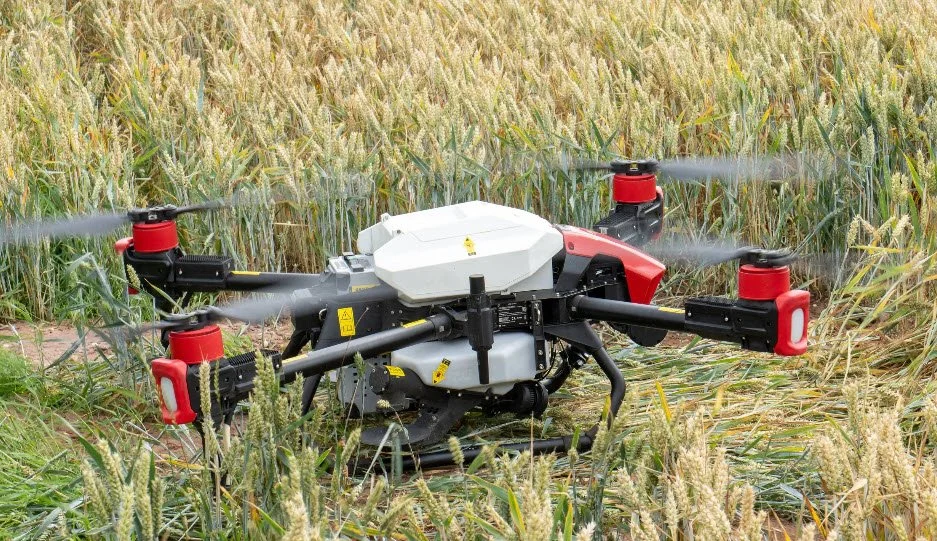
The machines doing this work are not toys. A typical agricultural drone is a heavy-lift multicopter, often a DJI Agras model or similar, with a hopper underneath and a spreading disc that flings seed out in a controlled pattern. The pilot plans the flight on a tablet, sets the rate, and the drone flies itself using RTK GPS for centimetre-level accuracy. That is the same correction signal used by modern tractors for autosteer, and it means the seed lands where you intended, not two metres off to the left.
Variable rate seeding is where this really shines. If you have a field with patches of sandy soil, a wet hollow, and a decent clay loam, a drone can vary the seed rate on the fly. The map is loaded before the flight, and the drone adjusts its output as it crosses each zone. You stop wasting expensive hybrid seed on ground that will not sustain it, and you stop under-sowing the good areas. That is the kind of precision that shows up in the yield map at harvest.
Beyond seeds: spreading and spraying in one platform
What makes drone seeding services even more attractive is that the same platform does other jobs. The hopper can just as easily hold slug pellets, fertiliser, or a liquid pesticide application. For many farms, the drone pays for itself across several tasks, not just one.
Slug control is a classic example. After a mild, wet autumn, slugs can wipe out a freshly drilled oilseed rape crop in a matter of nights. A drone can spread pellets across the field quickly, even when the soil is too soft for a quad bike or a tractor. The pellets land evenly, and the timing can be spot on because the drone is not slowed by gates or headlands.
Fertiliser spreading is another job where drones earn their keep. Small fields with awkward shapes are a nightmare for a large spreader. The overlaps and misses are hard to avoid. A drone flies precise lines, and the fertiliser goes exactly where the crop needs it. On steep ground, where a tractor feels like it is about to tip, a drone is completely at home.
A second look at no-till and regenerative systems
No-till farming and regenerative agriculture are built on the idea of disturbing the soil as little as possible. Drone seeding fits that philosophy perfectly. You are not ploughing, not cultivating, not even driving over the field. You are placing seed on or near the surface and letting the natural soil biology do the rest. For farmers trying to build soil health and increase carbon sequestration, this is a powerful tool.
I know a grower in the East Midlands who has been using aerial seeding for three seasons to establish cover crops into standing maize stubble. The maize is harvested for silage, the drone flies the same afternoon, and the cover crop is up before the leaves have even started to turn. He says the soil is visibly darker now, with more worms and better infiltration. He credits the early cover crop establishment for much of that change.
Regenerative agriculture is not a fad, but it is demanding. It asks you to rethink every pass you make. Drone seeding services let you add a green bridge between cash crops without adding a single wheel mark. That is why they are becoming a standard tool in the regenerative toolkit, right alongside roller crimpers and diverse rotations.
The learning curve and the practical limits
None of this is to say drone seeding is a silver bullet. There are real limitations. Seed placement is on the surface, not in a furrow. That means you need moisture and good seed-to-soil contact, and you may need a light harrow or a roll afterwards to tuck the seed in. On a baked dry seedbed in April, aerial seeding will struggle. The technology rewards good planning, not wishful thinking.
Battery life is another constraint. A heavy-lift drone might fly for ten to fifteen minutes per load, then need a recharge or a battery swap. That is fine for a 20-acre field, but it will not replace a 12-metre drill on a 500-acre block. The smart approach is to use drones for the awkward, the urgent, and the delicate, and leave the big flat fields to the tractor.
There is also a skill element. Flying a drone in a stiff breeze, near trees, or close to power lines takes practice. The best operators are the ones who understand both the aircraft and the agronomy. They know that a 2 kg per hectare rate of tiny grass seed behaves very differently from a 120 kg rate of peas. They adjust their flight lines and their disc speed to suit the seed size and the wind.
What the next few seasons might bring
The manufacturers are not standing still. DJI's Agras range keeps getting bigger payloads and smarter software. Yamaha has been in this game for years with its larger fixed-wing and helicopter platforms, and Aerovironment is pushing into the agricultural space with different approaches. The trend is towards longer flight times, higher capacity, and better integration with farm management software.
I would not be surprised to see drones doing more than just seeding and spraying in the near future. Crop monitoring is already a natural fit. A drone with a multispectral camera can spot nitrogen stress or disease pressure long before the eye can. That information can then feed straight back into a variable rate seeding or fertiliser map for the next pass. The drone becomes the eye and the hand in one machine.
There is also growing interest in using drones for precision seeding of individual trees in agroforestry or for broadcasting wildflower mixes on conservation margins. The same technology that spreads cover crops can spread a pollinator mix along a field edge, and that is a small thing that can make a big difference to biodiversity.
Is it time to book a drone?
If you are still on the fence, the best advice is to start small. Find a field that is awkward, wet, or just too small to justify pulling out the big kit. Try a drone service for your cover crop or your spring reseed. Compare the establishment against your usual method, not just in plant counts but in soil moisture, weed pressure, and the time you saved.
Drone seeding services are not about replacing the farm's core machinery. They are about adding a new tool that works alongside what you already have. They give you the ability to act at the right moment, even when the ground says no. In a season where every day counts, that timing can be the difference between a crop that limps through and one that thrives.
The technology is here, the operators are getting better, and the results are increasingly hard to argue with. The sky has become part of the farm, and the seeds are landing where they are needed most.